

Energy House 2.0: The Future of Home Building
Ever wondered what the homes of the future will look like—or more importantly, how they’ll perform? British Gypsum and Isover are back with the sixth episode of the Building Better series, and this time, we’re going inside one of the most advanced housing research facilities in the world: Energy House 2.0.
Located at the University of Salford, this groundbreaking project is more than just a modern build—it’s a controlled environment where researchers can test how homes perform under extreme conditions. Think of it as a crystal ball for construction: we can simulate any climate on Earth and even predict how buildings will respond to future environmental challenges.
It’s similar to a high-tech weather machine, simulating everything from icy winters to scorching summers, rainstorms to blazing sunshine, all within a fully sealed chamber.
Built for the Future
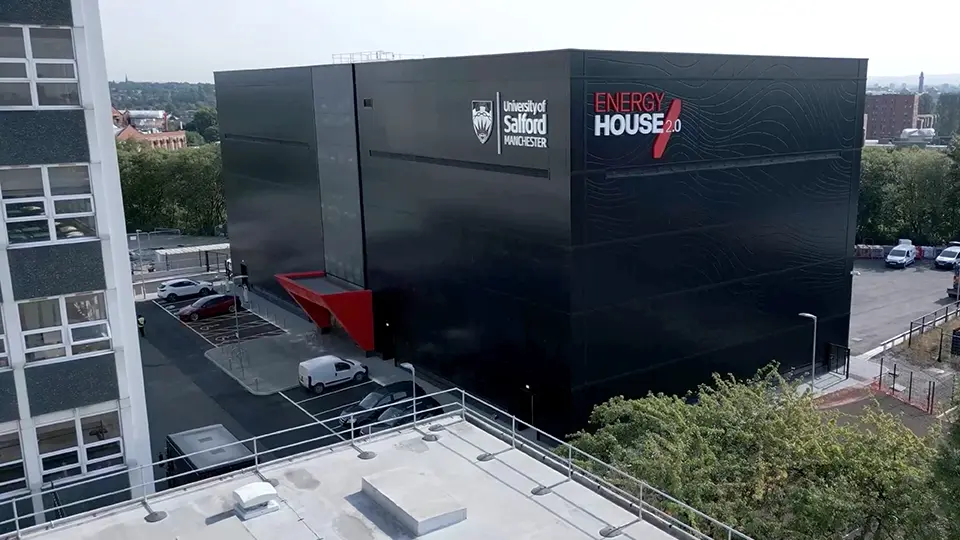
Energy House 2.0 isn’t your typical test home. It's the world’s first fully climate-controllable new-build house, a three-bedroom detached property designed to meet the future of housing regulations and sustainability.
Backed by British Gypsum and Isover – both part of Saint-Gobain, Energy House 2.0 is a space where innovation meets real-world application.
The project builds on the work of its predecessor, Energy House 1, which featured a Victorian end-terrace. By comparing modern and traditional builds under controlled conditions, the research team is helping to shape how we design, build, and retrofit homes for a net-zero future.
Behind the Scenes
The episode takes us on a tour with Professor Richard Fitton, a leading figure in energy performance research at the University of Salford.
With a lot of uncertainty in field testing conditions, Energy House 2.0 allows us to recreate the climate of any location on Earth—and even fast-forward into the future. In Energy House 2.0, we can simulate 30, 50, even 80 years of climate change to see how homes might cope.
This capability directly supports Saint-Gobain’s mission to make the world a better home. Traditional field testing can show a performance gap of up to 150% between design and actual energy efficiency, but Energy House 2.0 narrows that gap to less than 10%, this means confidence in material selection and system design.
Precision Testing
From U-values and airtightness to thermal imaging and insulation efficiency, Energy House 2.0 validates every aspect of our product performance. The ability to recreate consistent and extreme conditions helps remove guesswork from the equation, giving architects, engineers, and developers hard data they can trust.
This kind of climate-controlled testing is a powerful accelerator for innovation. It gives us data with better than 5% accuracy, so we know exactly how these homes perform before a brick is laid - a huge leap forward in our journey toward zero carbon.
This translates to reduced risk, improved performance predictions, and confidence that our materials will deliver on their promises for decades to come.
Building Better, Together
By opening the doors of Energy House 2.0, we aren’t just showcasing cool technology—we’re reinforcing a commitment to smarter, more sustainable living. It’s about rethinking how we approach the built environment and ensuring that the homes we create today can stand up to the challenges of tomorrow.
Watch the full episode below and learn more about how we’re building a better tomorrow.
Following on from Energy House 1, take a step further into the future with Energy House 1.0 and learn all about how we’re continuing to push technological boundaries.