

Commercial office retrofit in practice: lessons from No.1 Poultry
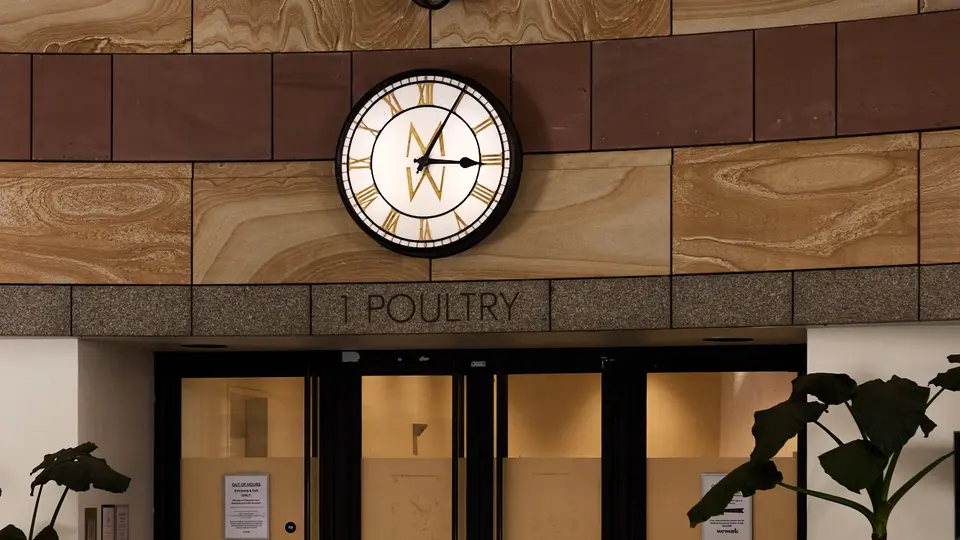
Commercial office retrofit in practice: lessons from No.1 Poultry
The launch of UKGBC’s Innovation in Commercial Retrofit: A Live Project Demonstrator comes at a critical moment for the office sector.
The challenge is no longer identifying solutions. It’s delivering them, within live projects, under real constraints, at the scale required to meet both regulatory pressure and market demand.
Using No.1 Poultry as a live test case, the demonstrator moves the conversation forward. It shows what happens when innovation is treated as part of the core delivery model, not something added late in the process.
From ambition to delivery
Commercial office retrofit is under growing pressure from multiple directions:
- tenant expectations for higher-performing space
- regulatory requirements, including MEES
- rising operational costs
- and the need to address both operational and embodied carbon
UKGBC highlights that energy use in commercial buildings alone accounts for nearly a quarter of the built environment’s carbon footprint.
Despite this, many retrofit projects still follow delivery models designed around new build - where solutions are introduced late and innovation is constrained by decisions already made.
The No.1 Poultry project demonstrates a different approach: starting with innovation early, and structuring the project around it.
Embedding innovation earlier
A key shift in the demonstrator is timing.
Applying the UKGBC’s Innovation Map from RIBA Stage 0–1 enabled solutions at No.1 Poultry to be evaluated before key project decisions were fixed.
In practice, this enabled:
- early engagement with solution providers
- assessment of technical and commercial viability
- clearer ownership of decisions across the project team
This is consistent with a broader shift we are seeing across the retrofit of offices: the most effective projects are those that front-load decision-making, not defer it.
Designing as a system, not a set of components
Another defining feature of the project is how decisions were made.
The Innovation Map structures interventions across building systems - including energy, materials and building fabric - enabling teams to consider not just individual products, but how they work together.
At No.1 Poultry, this translated into:
- aligning fabric upgrades with energy strategy
- linking airtightness improvements with system sizing
- considering material selection alongside circularity objectives
This reflects a key principle for office retrofit: performance is delivered through integration, not specification alone.
Façade and glazing: early decisions, wider impact
Within this system-led approach, façade and glazing decisions played a critical role - not in isolation, but as part of a wider building fabric strategy.
On this project, these decisions were shaped by:
- the constraints of a Grade II* listed building
- the need to improve thermal performance
- and the requirement to integrate new solutions with existing systems
Because of these factors, glazing could not be left to later stages. Early engagement allowed the team to test what was technically and commercially viable within the project constraints.
The outcome was a combination of glass solutions, including:
- vacuum-insulated glazing for targeted applications
- lower-carbon glass solutions, such as ORAÉ®, where different performance and scale requirements applied
- and circular approaches to recovering and remanufacturing glass
Together, these decisions show how façade strategy sits within a broader set of interventions - influencing energy performance, embodied carbon and long-term building use. As a result, solutions were not just identified, but integrated into the design, supported by earlier engagement and clearer ownership across the project team.

Circularity built into delivery
A further shift highlighted in the demonstrator is how circularity is treated.
Rather than being a secondary exercise, material reuse and recovery were considered from the outset - influencing both strategy and specification.
In the case of glass, this included recovery and remanufacturing into new products, reducing reliance on virgin materials and supporting carbon reduction objectives.
For offices, where refurbishment cycles are frequent, this approach reflects a more realistic model of long-term asset performance.
What this means for commercial office retrofit
The value of the demonstrator is not in a single project or set of technologies. It is in the approach to delivery.
For the office sector, this reinforces three practical shifts:
1. Start earlier
Innovation needs to be embedded before key decisions are fixed.
2. Think in systems
Performance outcomes depend on how solutions interact across the building.
3. Build in circularity
Material reuse and recovery need to be part of the strategy, not an afterthought.
These are not theoretical principles. They are being tested in live projects and shown to be deliverable within commercial constraints.
Supporting scalable change
For us at Saint-Gobain, this aligns with our focus on supporting retrofit through material innovation, circular solutions and collaboration across the value chain.
The No.1 Poultry project provides a useful reference point for how these elements come together in practice, and how innovation can move from concept to delivery.
The next step for the sector is not to replicate individual solutions, but to replicate the approach - unlocking the value of applying these principles across a wider pipeline of office retrofit projects.