
How to achieve thermal comfort in an education building
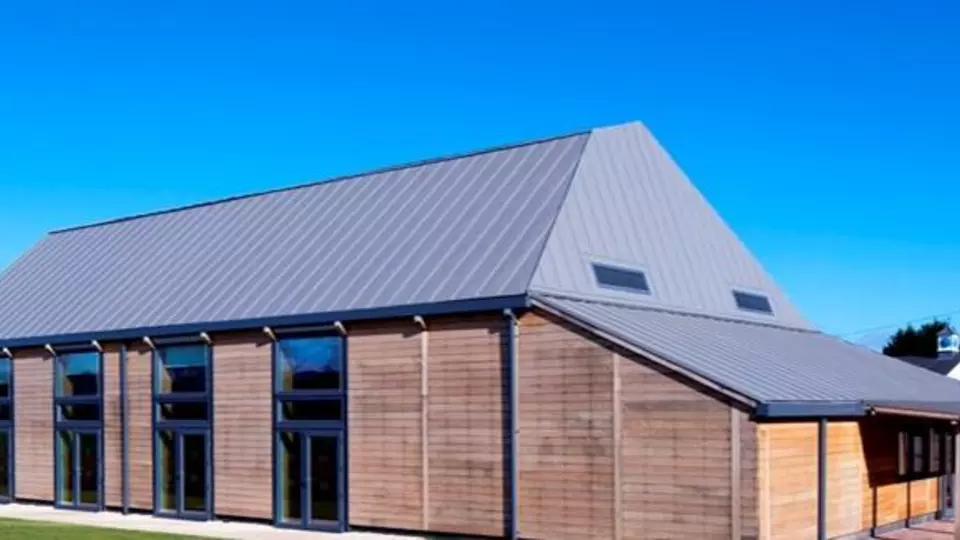
Bartholomew Barn, part of King’s Hawford junior school, in Worcester, is the first completed Multi Comfort building in the UK. It is also a certified Passivhaus building. Here, we look at how the design, building materials and construction techniques helped achieve exceptional levels of thermal comfort.
Thermal comfort in schools: The design challenge
King’s Hawford prides itself on offering an outstanding educational experience. Set in 30 acres of parkland, it comprises sports pitches, a forest school, playground, indoor swimming pool, design, history, geography and music facilities.
While the school had an existing hall, used for sports and assemblies, it required an additional space for sports, music and drama, as well as external events. The new hall also needed a kitchen and servery, changing facilities, showers and bathrooms.
As a family-centred school focused on making children feel valued, happy and optimistic, creating a space that’s enjoyable to use and encourages learning and development was vital.
Because Bartholomew Barn is used for several different purposes, a key challenge was to make sure it provides a comfortable temperature for all users – regardless of the activity they’re doing.
Achieving thermal comfort through design and specification
By adopting the Multi Comfort approach, the design of the hall considered the effects of temperature, humidity, ventilation and air flow to achieve a balanced, but flexible level of thermal comfort to accommodate the different activities that take place inside.
This was achieved through a highly insulated building fabric, using a combination of Saint-Gobain products and systems for the floor, roof and walls, with considered junction design and detailing to drive considered design and provide continuity in the building envelope performance.
Some of the products and systems used included:
- LECA® Insufill: This lightweight expanded clay aggregate offers excellent insulation and free-drainage properties, and was used underneath the concrete slab of the barn to improve its thermal properties.
- Celotex Insulation: A rigid foam insulation (PIR) solution with good thermal properties, making it an effective product to achieve high thermal performance in pitched roofs, walls and floor applications – especially where space is at a premium.
- Isover Timber Frame Batt: With thermal conductivity of 0.035W/mK, this product reduces heat loss from the building envelope and is especially useful for applications in wall cavities where it would be difficult to install rigid insulation materials.
A mechanical ventilation and heat recovery (MVHR) system was also incorporated in to the design to maintain a supply of clean, fresh air to help pupils stay alert and productive, while retaining as much heat as possible.
Because Bartholomew Barn sometimes hosts larger events with lots of people – who would collectively radiate more heat and cause the hall to feel much warmer – features like automatic opening skylights were built into the design. Adding these features helps dissipate warm air as needed to maintain optimum levels of thermal comfort.
Furthermore, Multi Comfort school design has a strong outdoor focus to give a sense of wellbeing and control, as well as create a productive learning environment. By placing floor to ceiling windows on the southern façade of the hall, the design of the hall takes advantage of natural light and scenic views, while using solar heat energy to maintain a comfortable temperature.
Thermal comfort results
Since its handover, Bartholomew Barn has undergone continuous monitoring and scheduled testing to compare its performance in-use versus the parameters set out at the design stage.
The thermal comfort of the building is being measured and monitored in a number of ways, and tests so far reveal successful results, as outlined below:
- Internal and surface temperatures: Aim to maintain a comfortable internal and surface temperatures all year round.The occupied air temperature has been maintained between 18 and 22 ̊C. Thermography surveys show consistent surface temperature throughout the building.
- Heating and cooling energy demand: Criteria 15kWh/m2/pa. This has been monitored through regular meter readings and automated meter and heat flow readings. The initial monitoring periods suggest a primary energy demand of 4kWh/m2/pa, however this figure will be refined and confirmed as the monitoring period increases.
- Relative humidity: Criteria 40 - 70%. Humidity sensors have been installed and are linked to an automated data logging system. To date the hall has performed within the designed humidity range.
- Overheating prevention: Limit value 10% - Percentage of hours in a year exceeding 25 ̊C. Air temperature sensors have been installed and are linked to an automated data logging system. The hall hasn’t exceeded 25 ̊C for more than 10% of the occupied time during the first 18 months of use. This parameter will continue to be monitored for 24 months.
- Thermal bridging: Target ≤0.01W/mK. Thermal bridge junctions and their impacts have been reviewed through the use of thermographic surveys. The surveys have shown that considered detailing and care take during both design and installation has minimised bridges to a point where surface temperature variables are negligible. (Link to the new article about thermal bridging)
As well as carefully tracking and monitoring the thermal comfort of the building through the data outlined above, feedback from staff and pupils has been positive, with many saying the space feels warm and comfortable.
Joel Turvey, Director of Studies, said: “You find it’s a consistent temperature, all the time, whenever you come in. It stays cool when it’s hot outside but also, it’s nice and warm when it’s cold outside.”
Top marks for the UK’s first Multi Comfort building
As this case study shows, using the right combination of building materials and construction methods, teamed with the right design installation and site support, can help achieve a consistent level of insitu thermal comfort which is representative of that modelled during design.
Using the Multi Comfort concept for Bartholomew Barn, King’s Hawford has raised the standard for educational buildings, creating a space that is as efficient to run and manage as it is effective in helping pupils learn and develop.